.png)
Nvidia Options Are Pricing a $300 Billion Earnings Swing. Here's What The Data Shows.
Wall Street expects revenue to nearly double. The options market expects a 5.7% move, calls are running three to one over puts, and protection is quieter than a normal Tuesday.

At a Glance
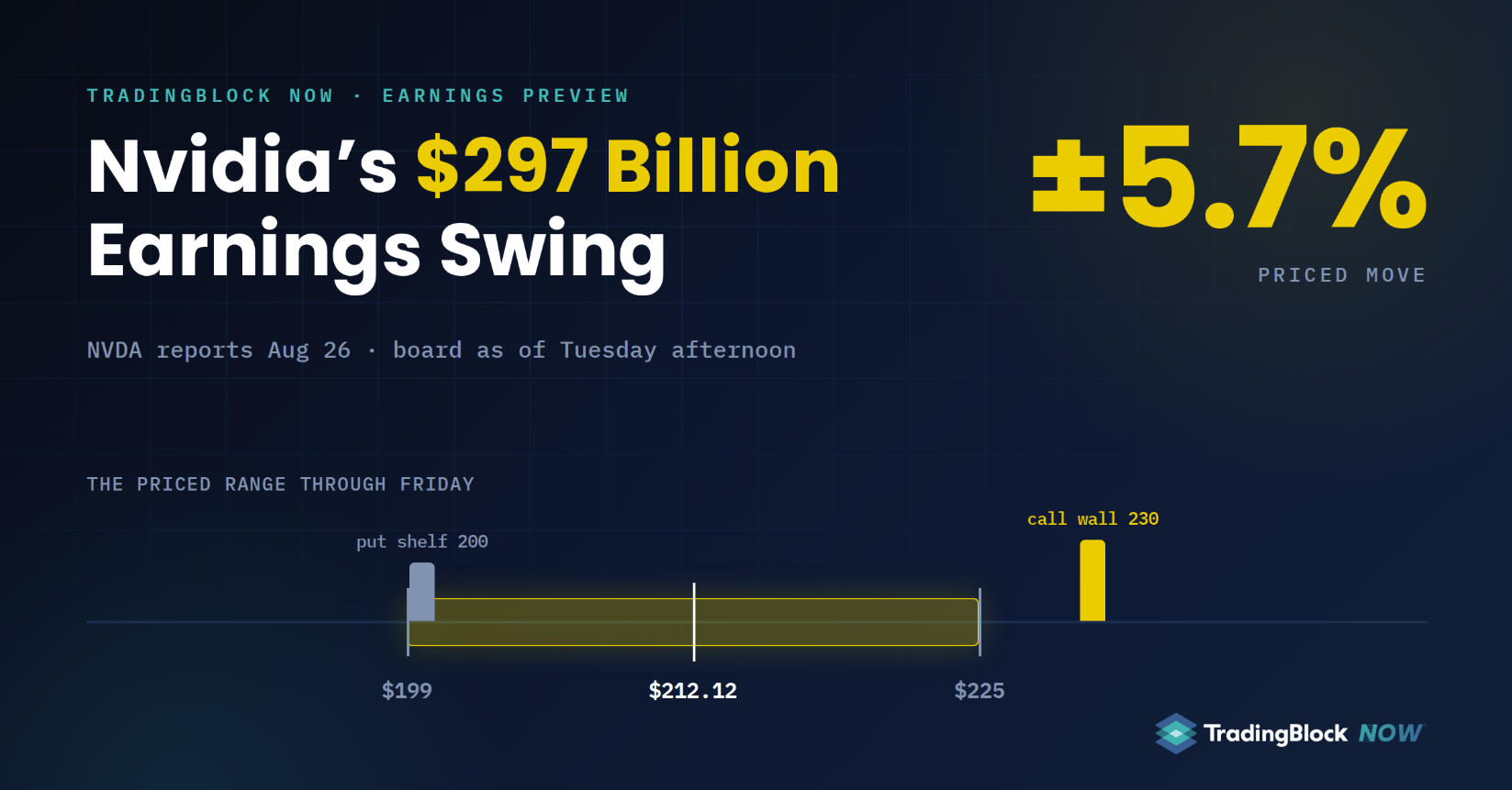
- ±$12.11 earnings move priced: About 5.7% either way, representing roughly $297 billion in market value.
- Calls dominate the board: Call volume is running roughly 3-to-1 over puts, while put volume is below its normal pace the day before earnings.
- Clear battle lines: A call wall sits at $230 and a put shelf at $200, with Nvidia at $212.12 almost directly between them.
Nvidia reports Wednesday after the close, and the options board has already put a number on it. As of Tuesday afternoon, with the stock at $212.12, options priced an earnings move of ±$12.11, about 5.7% in either direction. Against Nvidia's roughly $5.2 trillion market cap, that is a swing of about $297 billion, more than the entire market cap of about 90% of S&P 500 companies by Reuters' math. Reuters, working from earlier pricing, put the figure at $280 billion on a 5.4% move. Tuesday's board prices more.
The setup is tense. Nvidia fell seven straight sessions before Tuesday's 1.7% bounce, its longest slide since 2022 per CNBC, and its 11.7% gain this year trails the Philadelphia Semiconductor Index's 61%. The AI trade's flagship has been the sector's laggard.
What Wall Street Expects
On its May earnings call, Nvidia guided this quarter to $91 billion in revenue, plus or minus 2%. Consensus sits at $92.2 billion per LSEG estimates cited by CNBC, nearly double a year ago, with data center revenue expected near $86.3 billion and adjusted earnings around $2.09 per share, roughly twice last year's figure. BofA, at a Buy rating and a $350 target, models $94 to $95 billion.
The Bar Is the Guide, Not the Quarter
Almost nobody expects the quarter to miss. The number that moves the stock is October guidance: consensus sits near $104 billion and BofA expects $107 to $108 billion. Behind that, analysts want the split between hyperscaler customers and everyone else, gross margin durability, and anything on China. Bernstein's Stacy Rasgon put the skepticism plainly to CNBC:
A lot of headlines and big numbers and not a lot of details…Stacy Rasgon, Bernstein, on the AI buildout, to CNBC
The other headline is the next chip. Jefferies expects Vera Rubin products to reach about 12% of GPU revenue next quarter and more than 40% the quarter after, per TradingKey, and Bloomberg News reported over the weekend, via CNBC, that Nvidia has told customers Rubin and Blackwell server prices rise more than 15% in early 2027. A beat with a soft guide is the scenario that hurts.
What the Options Market Is Pricing
The expected move is the swing options price between now and a given expiration, backed out of the at-the-money contracts. It covers one standard deviation, so the stock finishes inside it roughly two thirds of the time, and it says nothing about direction.
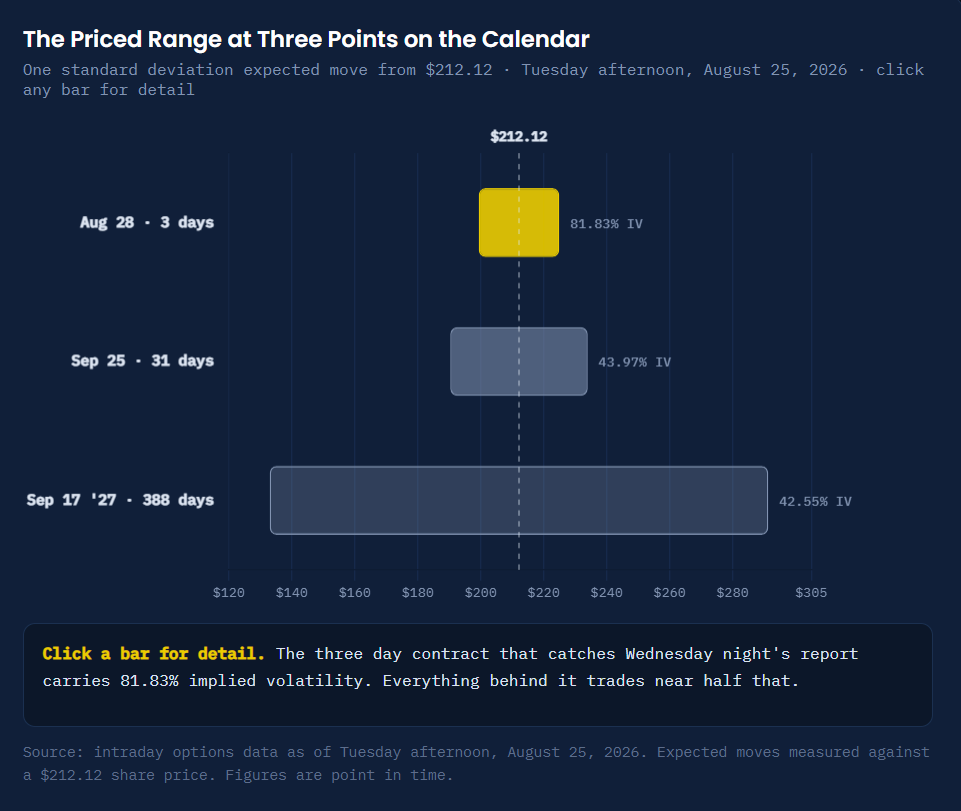
With the stock at $212.12 Tuesday afternoon, Friday's August 28 expiration, three days out, priced 81.83% implied volatility and a ±$12.81 move, about 6%, roughly $199 to $225. One month out, September 25 priced 43.97% and ±$21.84, roughly $190 to $234. About a year out, September 2027 priced 42.55% and ±$79.15, roughly $133 to $291. The three day contract carries nearly double the volatility of everything behind it, and the one month and one year readings are almost identical. Wednesday night is the only event on Nvidia's calendar the market charges extra for.
Calls Are Running Three to One Over Puts
Nvidia traded about 1.38 million contracts by Tuesday afternoon: 1,038,322 calls against 338,880 puts, a put/call ratio of 0.33. Measured against the name's own normal pace, call volume ran about 1.6 times its average while put volume ran below its usual clip. The day before a binary event, demand for protection was quieter than an ordinary Tuesday.
The flow leans small and speculative. Just over half of call volume, 51%, sat in contracts with a delta between 0 and 20. Delta estimates how much an option moves per dollar of stock movement and doubles as a rough probability of finishing in the money, so a sub-20 delta call is a long shot by the market's own math. Calls also printed at the ask slightly more often than at the bid, which leans toward buyers initiating, though prints alone cannot prove who started a trade.
The Crowd Wants Friday's 230 and 240 Calls
The two busiest contracts on the entire board were Friday's 230 and 240 calls, at 148,389 and 120,411 contracts. Both strikes sit above the top of the priced move near $225. At $1.22 and $0.41 per share, these are cheap tickets on an outcome the market itself calls unlikely, and traders bought them in size.
A Call Wall at 230, a Put Shelf at 200
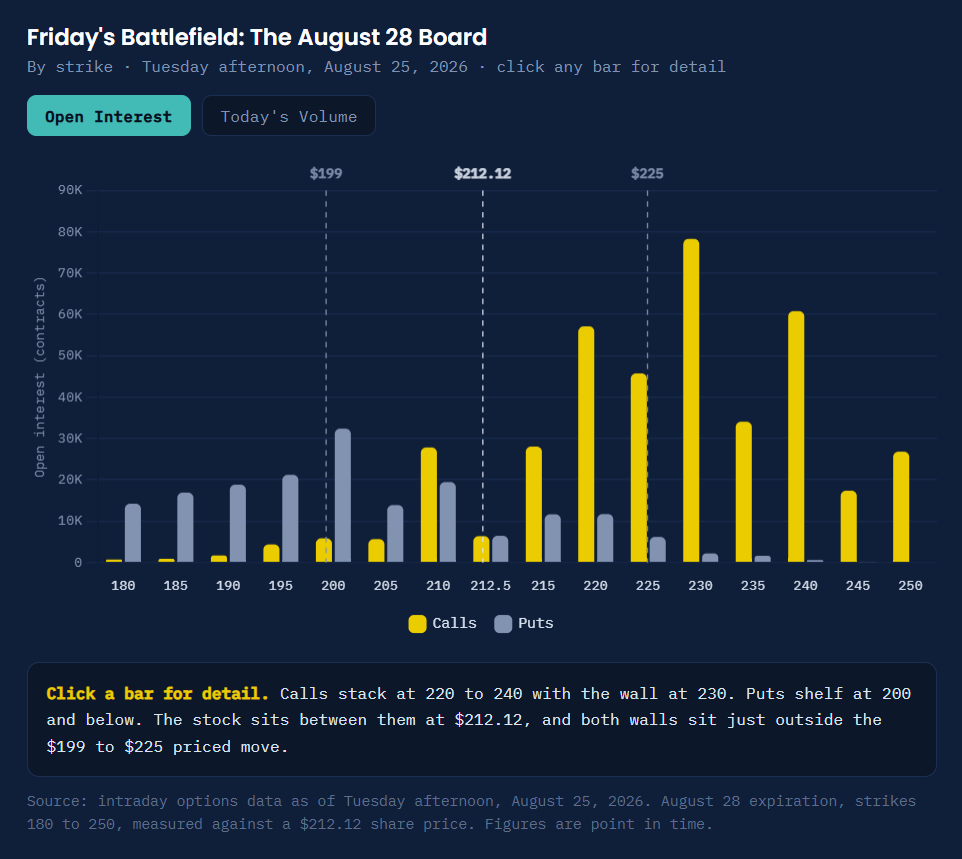
Open interest, the count of contracts already open rather than traded today, draws the battlefield. Nvidia carries about 7.58 million open calls against 6.40 million open puts across all expirations. On Friday's board the positions stack at round numbers: calls at 230, 240 and 220, puts at 200 and below. The stock sits almost exactly between the two, and both walls sit just outside the edges of the expected move. Chart watchers draw nearly the same map: NYSE floor veteran Jay Woods told CNBC he is watching $195 below and the low 230s above, within a few dollars of the put shelf and the call wall. New to the board layout? Start with option chain explained.
Options Are Cheap by Nvidia's Own Standard
Nvidia's overall implied volatility of 44.56% sits at just the 46th percentile of its own past year. The day before earnings, options on the biggest stock in the market are cheaper than they were on a typical day in the last twelve months. Options data firm ORATS reads that pricing the same way.
Some complacency.Matt Amberson, founder of ORATS, on Nvidia's pre-earnings options pricing, via Finimize
How This Compares With Past Earnings
Even at 5.7%, the priced move is small by Nvidia's own history. The average post-earnings swing over the past 12 quarters is 7.4%, per options data firm ORATS, and the implied move ahead of the May report was 6.5%.
Susquehanna's derivatives desk offers the counterargument: for two years Nvidia's actual moves have frequently landed below what options implied, as the era of shock beats has faded.
There's just not a huge view that they're going to catch everybody off-guard…Chris Murphy, co-head of derivatives strategy, Susquehanna, to Reuters
And one more pattern cuts both ways. Nvidia keeps beating estimates, yet it has traded lower after five of its last six reports, per CNBC. How premium deflates after a report is covered in our IV crush guide, and the gap between priced and delivered movement is the subject of implied vs realized volatility.
The Names That Trade With It
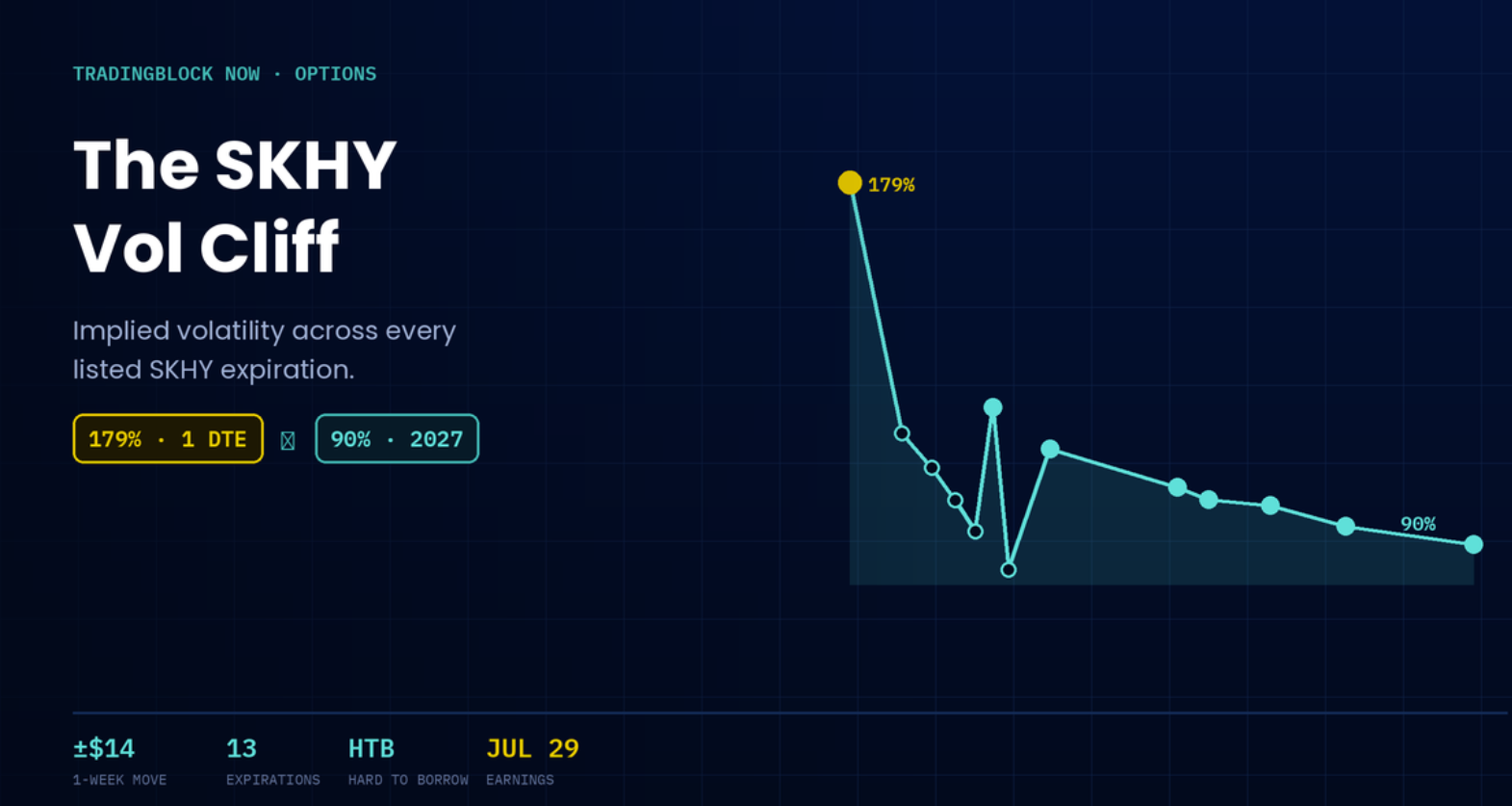
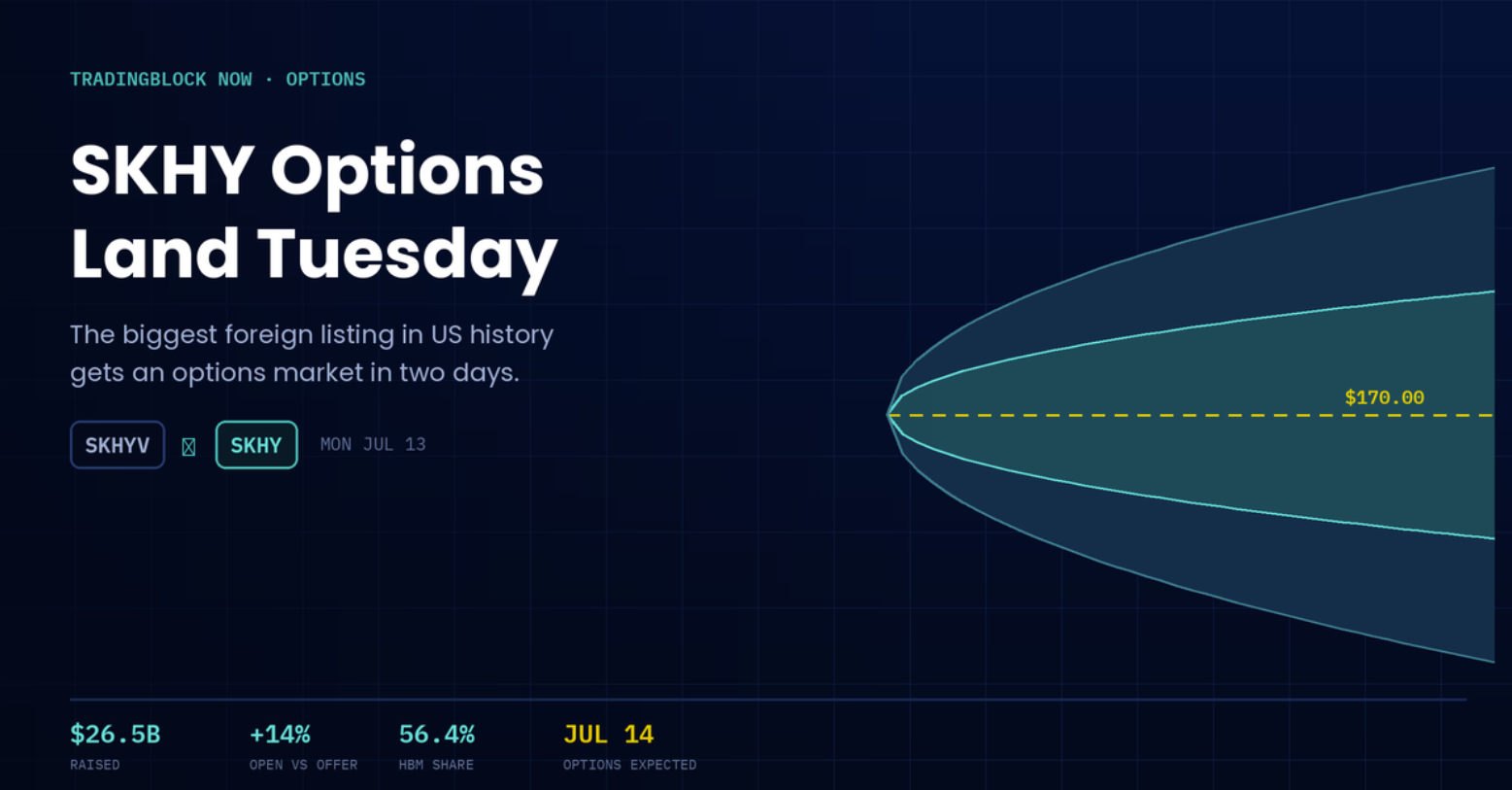
Susquehanna's Chris Murphy has argued the ripple effects may matter more than Nvidia's own move. Taiwan Semiconductor manufactures every Blackwell and Hopper chip Nvidia sells and fell about 3% Monday. The memory names are the highest beta line: SK Hynix dropped 4.6% in Seoul Tuesday with the Kospi down 2.7%, and its US-listed shares trade as SKHY, a board we covered when SKHY options launched in July. Micron, Sandisk, AMD and Broadcom all trade off whatever Nvidia says about the capex cycle.
The one-line version: a guide above $104 billion likely lifts the whole complex, and a soft guide hits the memory names hardest.
Three Ways Traders Could Structure a View
None of the following is a recommendation. Quotes are from Tuesday afternoon and will have moved. Three defined risk structures on the August 28 expiration, one per view, each risking its full debit, or its width less the credit, if the stock finishes on the wrong side.
- Bullish: a bull call spread. Buy the 220 call @ $3.20, sell the 230 call @ $1.22. Net debit $1.98 ($198 per spread), max value $10.00, breakeven $221.98, inside the top of the priced move. Selling the 230, the strike the crowd is chasing, cuts the debit by a third and softens the volatility reset that punishes outright calls after earnings. Test your own strikes in the vertical spread calculator.
- Bearish: a bear put spread. Buy the 210 put @ $5.05, sell the 200 put @ $1.67. Net debit $3.38 ($338 per spread), max value $10.00, breakeven $206.62. This is the sell-the-news trade after four sold beats, and the short leg sits on the 200 strike where put positions are deepest. It profits if the stock simply revisits last week's lows.
- Neutral: a short iron condor. Sell the 230 call @ $1.22, buy the 240 call @ $0.41, sell the 200 put @ $1.67, buy the 190 put @ $0.47. Net credit about $2.01 ($201 per condor), max risk $7.99 ($799). Both short strikes sit at or beyond the edges of the priced move. It collects if the actual move lands inside the implied one, as it often has for two years, and it loses most of its width if this is the quarter that pattern breaks, so it gets sized small or skipped by traders who cannot wear that outcome. Map the payoff in the iron condor calculator.
Whatever the structure, the expected move is the yardstick. The market's normal range through Friday is roughly $199 to $225. A thesis that needs more than that is a bet against the market's own estimate.
Sources: TradingBlock platform, session data as of Tuesday afternoon, August 25, 2026 · Reuters via Investing.com · CNBC · CNBC on key levels · Bloomberg News via CNBC · Moomoo Options Chatter · Tickeron · Finimize · TradingKey · Investing.com Asia · The Motley Fool. Earnings date is company scheduled and subject to change.
Options involve risk and are not suitable for all investors. Prior to trading options, you must receive a copy of Characteristics and Risks of Standardized Options. Nothing here is a recommendation to buy or sell any security or to adopt any trading strategy. Example structures are for educational purposes only, use prices from a point in time during the session, and will change. Multi-leg strategies involve multiple commissions and assignment risk. Past performance does not guarantee future results.
FAQ
Options are pricing a move of about ±$12.11, or 5.7%, representing roughly $297 billion in market value.
Your Weekly Options Edge
Get the options insights that matter most each week.
More from TradingBlock Now
Stay informed with the latest market insights
.png)