SK Hynix Options Start Trading Tuesday. Here Is the Playbook.
SK Hynix just completed the largest US listing ever by a foreign company, and with SKHY options expected to start trading Tuesday, July 14, traders get almost immediate access to calls, puts, and spreads on the dominant AI memory supplier.

At a Glance
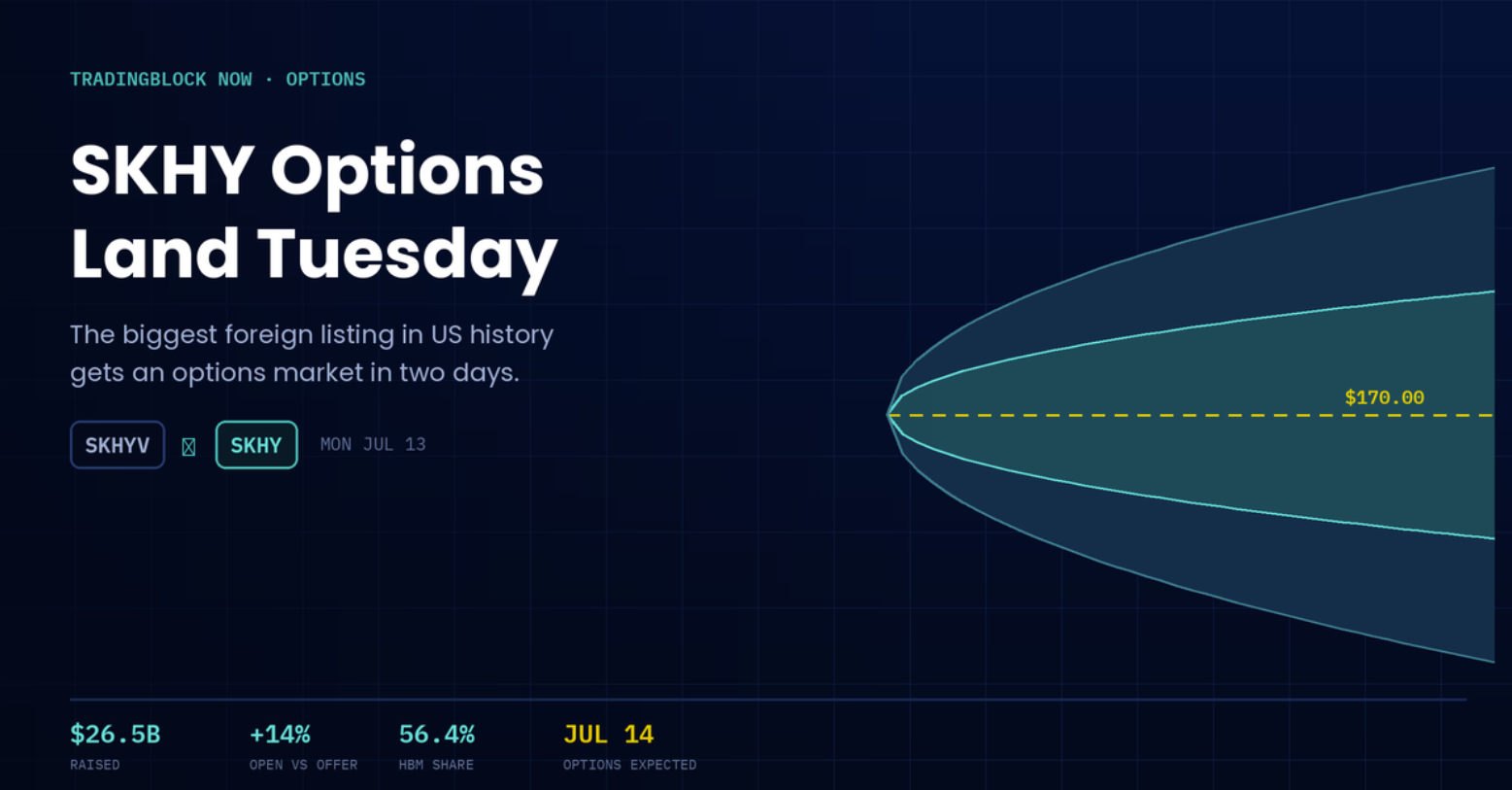
- SK Hynix raised $26.5 billion in the largest US listing ever by a foreign company. The ADRs opened at $170, 14% above the $149 offer.
- The ticker converts automatically from SKHYV to SKHY on Monday, July 13. Positions and price history carry over. Each ADR equals one tenth of a Seoul-listed common share.
- SK Hynix holds 56.4% of the high-bandwidth memory market per its SEC filing. Nvidia is its biggest customer.
- The ADR premium to the Korean shares can persist because the conversion mechanism only works freely in one direction.
SK Hynix priced 177.9 million American depositary receipts at $149 on Thursday night. The stock opened at $170 on the Nasdaq Friday morning, a 14% pop. The $26.5 billion raise is the largest US share sale ever completed by a foreign company, topping the record Alibaba set in 2014. Demand ran more than seven times the shares available. The debut valued the company around $1.27 trillion, which slots it in as the 11th largest name on US markets, just above Eli Lilly.
That alone would be a story. Here is why it matters more to options traders: Reuters reported Friday, citing sources familiar with the plans, that exchanges including Cboe and Nasdaq expect to list options on the new ADRs two business days after the debut. Count it out and contracts could be trading Tuesday, July 14.
New listings normally make traders wait. This one will not.
The mechanics first
Get the ticker right before Tuesday. The ADRs trade in when-issued mode under SKHYV through Friday. Regular-way trading begins Monday, July 13 under SKHY, per Nasdaq's listing notice. Each ADR represents one tenth of a Seoul-listed common share. The offering itself closes July 14, and the newly issued shares underlying the ADRs list on the Korea Exchange July 29.
Why these options are different
SK Hynix is not just another semiconductor name getting a US listing. It is the world's leading producer of high-bandwidth memory, the stacked DRAM that feeds Nvidia's AI accelerators. The company's own SEC filing puts its HBM share at 56.4%. Nvidia is the biggest HBM buyer, and the two companies announced a multiyear partnership in June when Jensen Huang visited Seoul.
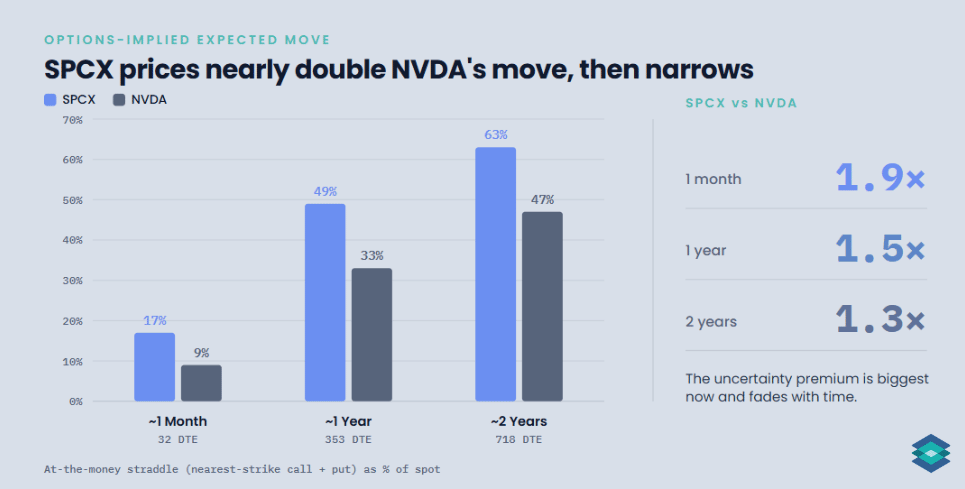
Until Friday, a US options trader who wanted exposure to AI memory demand had a short menu: Nvidia, AMD, Micron, Broadcom, or a sector ETF like SOXX. SKHY adds the dominant supplier of the memory layer itself. If volume builds, SKHY slots directly into the core AI options complex.
What to expect when trading opens
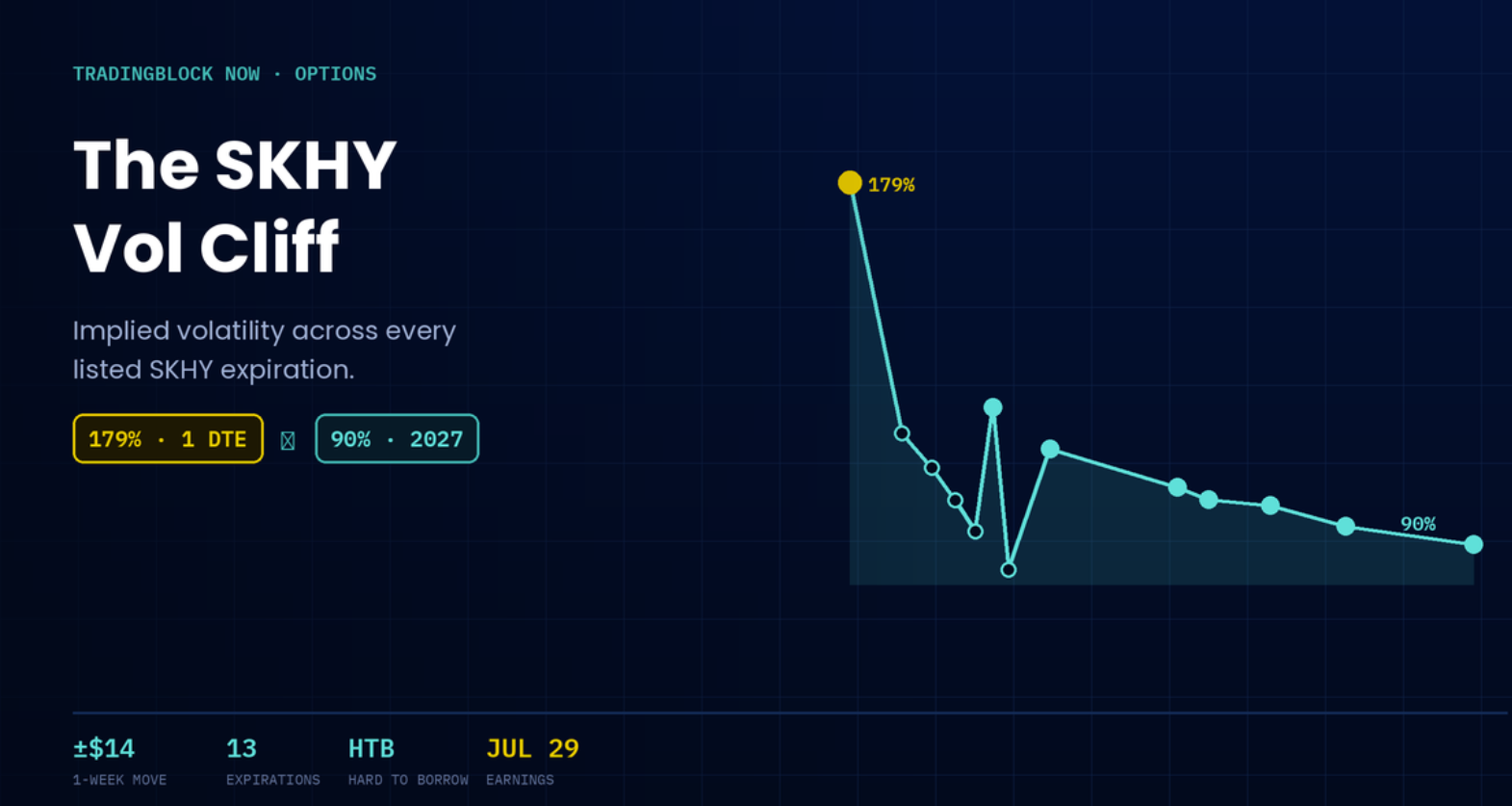
New high-profile option listings follow a pattern. Implied volatility prints high, markets start wide, speculative call flow shows up early, and dealer hedging of that flow can push the stock around. Expect all of it here. The debut also lands after a rough stretch for chip stocks, so the first prints in SKHY vol will double as a live reading on how much fear or greed is left in the AI trade.
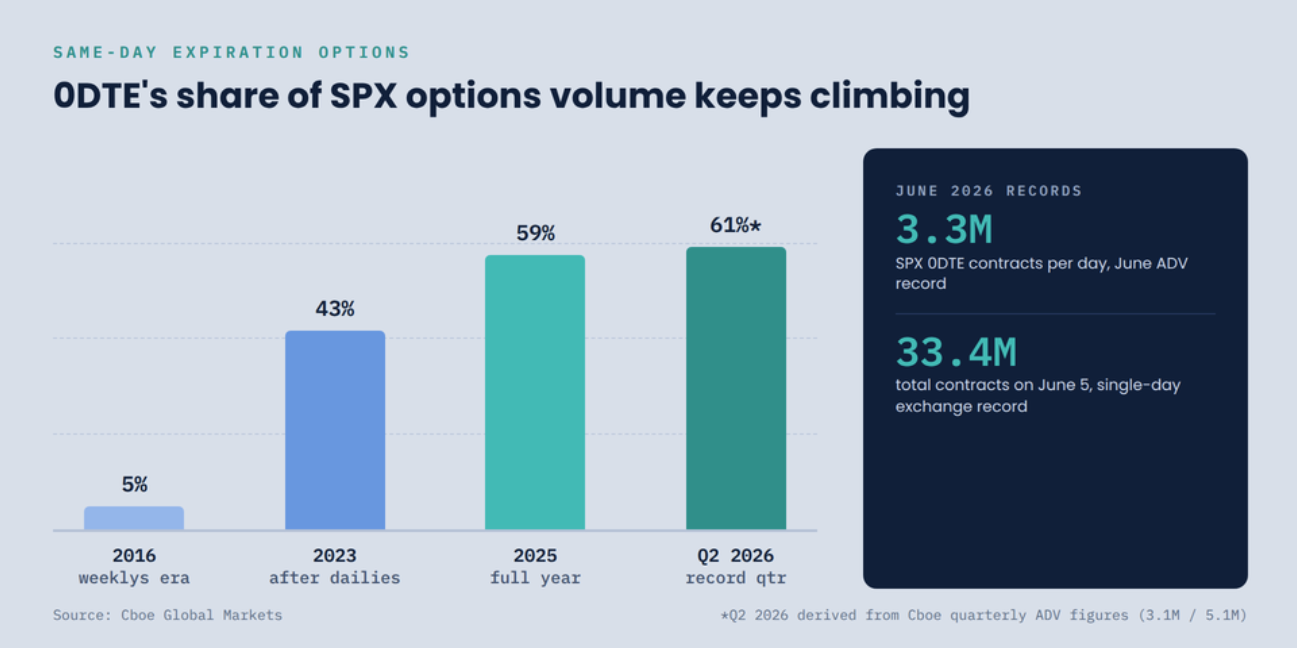
The freshest comp is SpaceX. Its options launched last month and drew record volumes almost immediately, proof that a hot new name can go from zero to one of the most active options boards on the tape in days.
One more wrinkle. With no trading history, IV rank and IV percentile will be useless on this name for months. There is no one-year range to compare against, so every read on whether SKHY vol is rich or cheap has to come from comps like Micron instead.
Since nobody can quote SKHY implied volatility yet, we built a tool for the wait. Set an IV level and see what the market would be pricing in. That expected move is what an at the money straddle is priced to capture. When real quotes print Tuesday, check your guess.
TradingBlock Now · Interactive
SKHY Expected Move Explorer
SKHY options are not trading yet. Pick an implied volatility and see what the market would price in. Score your guess when live quotes print.
Expected move = price × IV × √(days ÷ 365). Thick bar is one standard deviation (about a 68% range), thin bar is two (about 95%). Illustrative only, not a forecast or a recommendation. Options involve risk and are not suitable for all investors.
The premium is its own trade
Here is the part most coverage is skipping. The ADRs priced at roughly a 3.1% premium to the Seoul shares. At Friday's open near $170, against a Seoul close around $1,445 per common share, the premium was closer to 18%. HSBC thinks it can run to about 20%.
Textbook arbitrage says a gap like that should close fast. This one may not, because the conversion mechanism only works freely in one direction. ADR holders can cancel their ADRs and take delivery of Korean shares. Going the other way, buying in Seoul and creating new ADRs, can require approval from Korean regulators. Discounts get arbed away. Premiums can stick.
That asymmetry matters for options pricing too. A persistent premium, and the possibility it compresses, is a source of ADR-specific volatility that has nothing to do with DRAM prices, the memory chips that drive SK Hynix earnings.
What comes next
The product wave is already forming. At least ten fund managers, including Direxion and ProShares, have filed to launch single-stock ETFs tied to SK Hynix. The market also widely expects the stock to join the Nasdaq 100 at the December rebalance, which would bring steady passive buying from index funds.
Then there is the valuation gap. FactSet data at the debut puts SK Hynix near 5.4 times forward earnings against roughly 6.7 for Micron, even though the market expects SK Hynix to grow revenue and earnings faster this year. Part of the bull case for the ADRs is that a US listing, index inclusion, and US-style coverage close that gap over time.
Bottom line
Tuesday is the date. Brand-new options on the dominant AI memory supplier, opening into elevated volatility, with an ADR premium dynamic underneath it that most participants have never traded. Know the mechanics before the first print. And if you want a refresher before Tuesday, our free options trading course covers everything from expected moves to spreads.
Sources
Nasdaq Trader, Data Technical News #2026-11 (ticker schedule and settlement) · Reuters, options expected two business days after debut · Reuters, single-stock ETF filings · Bloomberg, debut and offering size · SK hynix, listing announcement · CNBC, company profile and Nvidia partnership · Direxion, SEC prospectus for the Daily SK Hynix Bull 2X ETF. Market share per the company's SEC filing; valuation figures per FactSet data reported at the debut.
Options involve risk and are not suitable for all investors. Prior to buying or selling an option, a person must receive a copy of Characteristics and Risks of Standardized Options, available from your broker or at theocc.com. This content is for educational purposes only and is not a recommendation. TradingBlock is a member of FINRA, NFA, and SIPC.
FAQ
The naked long call is considered to be an extremely bullish options trading strategy.
To calculate the profit on a short call option, subtract the current value of the option price from the premium received at the time of sale.
No, you cannot directly withdraw the premium of an option. However, if you are the option seller, you receive a credit for the option value when you sell it. If the option you sold expires out of the money, you keep the entire premium and can then withdraw those funds from your account.
Your Weekly Options Edge
Get the options insights that matter most each week.
More from TradingBlock Now
Stay informed with the latest market insights