.png)
A Quiet VIX And The Wildest Options Week Of The Summer
Palantir went up 29% when options priced an 11% move. SpaceX faced its first earnings report and a $100 billion share unlock in the same 72 hours. The VIX closed the week near 15. Here is everything that happened.

At a Glance
- Weak jobs shifted the Fed calculus: A major payroll miss reduced expectations for a September rate hike.
- Quiet VIX, wild stocks: Low market volatility masked extreme single-stock moves.
- Implied moves aren’t guarantees: PLTR moved nearly 3× what options priced.
- Earnings beats aren’t enough: AMD beat estimates but still sold off.
- Huge supply doesn’t guarantee selling: SpaceX rallied despite nearly 912 million shares becoming eligible for sale.
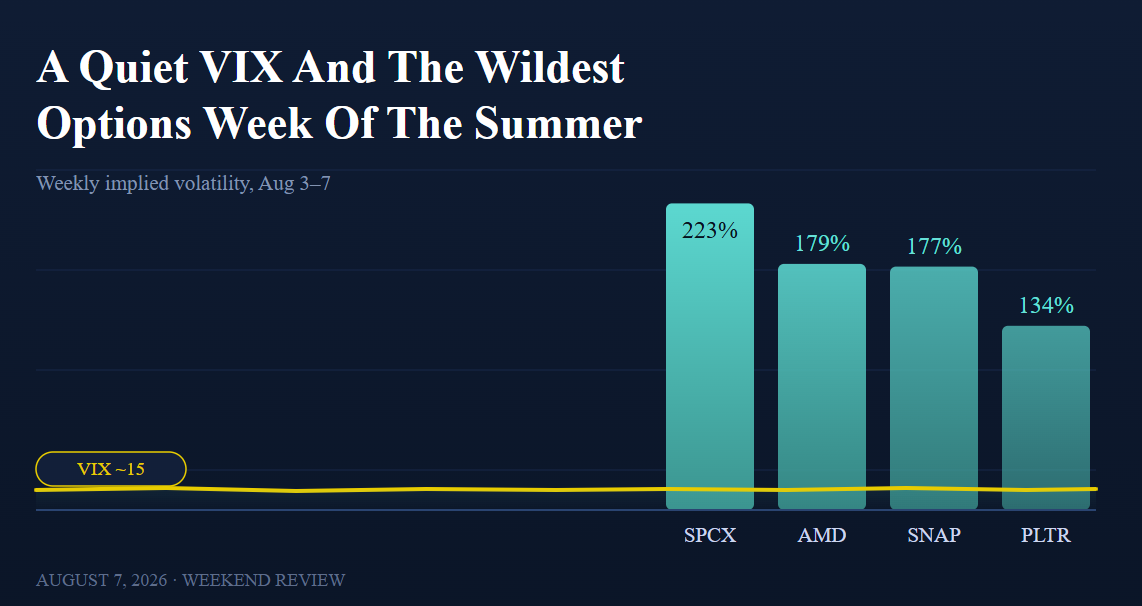
The VIX traded near 15 all week, which describes a quiet market. Individual stocks priced triple-digit implied volatility, which describes a violent one. Both readings were correct. When they separate this far, the earnings board stops being a hedge on the market and becomes its own trade.
If you only checked the fear gauge this week, you missed all of it.
The Cboe Volatility Index traded near 15 into Friday afternoon, closer to its 52-week low of 13.38 than to the 35.30 high. That number measures expected movement in the S&P 500 over the next 30 days. By that measure, nothing was happening.
Underneath it, four of the busiest boards on the market were pricing crisis-level movement. By Market Rebellion's mid-session reads early in the week, SpaceX weekly calls carried 223% implied volatility. AMD reached 179%. Snap hit 177%. Palantir printed 134%. Implied volatility is the market's forecast for how much a stock will move, baked into the option price itself. Readings like these usually show up during a selloff. This week they showed up during a record.
Here is how the five sessions actually went.
Monday · August 3Palantir Reports Into A Market That Had Given Up On It
Palantir walked into its report down 29% on the year. Investors had spent months backing away from expensive AI names, and short sellers had built roughly $2.7 billion in paper gains betting against this one.
Options priced an 11.4% move going into the report, per TipRanks' straddle math. That figure comes from the at-the-money straddle, the combined cost of a call and a put at the same strike, and it is the cleanest read on how far the market thinks a stock can travel.
The numbers landed after the bell. Revenue of $1.94 billion against $1.80 billion expected, up 93% year over year. U.S. commercial revenue up 149%. Adjusted earnings of 41 cents against 35 cents.
This quarter was otherworldly.Alex Karp, CEO of Palantir, in the company's August 3 earnings release
Tuesday the stock closed up 29.5%, roughly a point short of its best single day on record. Short sellers gave back about $3 billion in one session. Options had priced 11.4%. The stock delivered nearly three times that.
Tuesday · August 4Two Of The Wildest Boards On The Market Report The Same Night
AMD and SpaceX both reported after Tuesday's close, with their conference calls running nearly back to back.
AMD's options priced about an 8.5% move, an implied range near $440 to $523. The company beat on both lines, with adjusted earnings of $1.66 against $1.62 expected and revenue of $11.54 billion against $11.28 billion. Data center revenue grew 107% to a record $6.72 billion. CEO Lisa Su told analysts the company expects data center sales to double in 2027.
The stock gave back nearly 9% in after-hours trading and closed the next session down about 7%. One wrinkle strengthened the lesson rather than muddying it: AMD had rallied roughly 7% during Tuesday's regular session, so the implied move was measured off a price the stock had already left behind by the time the numbers hit.
Benzinga had flagged the trap two days earlier. By its count going into the report, AMD had closed lower the day after earnings in seven of 12 reports since August 2023, and it missed consensus only twice in that stretch. The problem was never the beat. The problem is what gets priced in before the beat arrives, and the premium collapse that follows the release. Our guide to IV crush after earnings covers why a front-week option can lose most of its value within minutes even when the stock moves your direction.
SpaceX had the harder setup. It was reporting as a public company for the first time, seven weeks after its June 12 debut, with no earnings history for anyone to price against. Front-week options were charging up to 223% implied volatility for the privilege. Revenue came in at $7.81 billion, up 92% and well ahead of the $6.93 billion expected.
Capital spending is what moved the stock. Second-quarter capex hit $18.37 billion against a $13.22 billion estimate, with $15.83 billion of it going to AI infrastructure. Shares fell about 8.6% after hours.
What Options Priced vs What The Stock Delivered
Week of August 3 to August 7, 2026 · SPCX figures as of Friday afternoon · click any bar for detail
| Name | Implied | Net actual | Path traveled | Result |
|---|---|---|---|---|
| PLTR | 11.4% | 29.5% | 30.9% | Underpriced |
| AMD | 8.5% | 7.0% | 8.9% | Near fair |
| SPCX | 17.7% | 3.1% | 16.1% | Path dependent |
Click a bar for detail. All moves are measured from each stock's last close before its report. Net move is where it settled afterward. Path traveled is the furthest it got from that same close in either direction, including after hours.
Sources: implied moves from TipRanks and Seeking Alpha option pricing snapshots taken before each report. Realized moves from CNBC and Quartz market coverage. Figures are point in time.
Thursday · August 6The Day SpaceX Was Supposed To Break
Thursday brought the event everyone had circled. Roughly 911.5 million SpaceX shares became eligible for sale as the first post-IPO lock-up expired, more than doubling the public float from 4.9% of shares outstanding to 11.8%. At Thursday's prices, that is roughly $100 billion of stock walking free in a single morning.
The stock dropped to $105.11 in early trading, more than 50% below its June peak and about 20% under the $135 IPO price. One early investor, Atlanta Falcons safety Jessie Bates III, told CNBC he planned to sell his entire stake.
Then it closed up 6.1%.
Friday it added another 11% in afternoon trading after Argus upgraded the shares to Buy with a $160 target. That put it on track for its best week since listing and the end of a four-week losing streak. Morgan Stanley kept a $300 base case. Bernstein raised its target to $248. Citi held at $200.
The trading lesson sits in the gap between the path and the close. An implied move is measured against where the stock eventually finishes, not the distance it travels along the way, and SpaceX showed why the distinction matters: the stock covered nearly the full implied range during the week yet ended only a few percent from where it started. Whether any given position made or lost money depends on the premium actually paid and when it was closed, which is exactly why the gap between what a stock travels and where it settles decides more earnings trades than direction does. That gap is the practical difference between implied and realized volatility.
More supply is scheduled. CNBC reports another 319 million shares could unlock in late August, with additional tranches through the fall before the full lock-up expires in December.
Friday · August 7A Bad Jobs Number Turns Into A Green Week
Friday morning reset everything. July nonfarm payrolls showed a loss of 23,000 jobs against a Dow Jones consensus of positive 83,000, with May and June revised down by a combined 103,000. The unemployment rate edged down to 4.1% from 4.2%, but for the wrong reason: labor force participation fell to 61.4%, its lowest in more than five years, meaning the rate dropped because people stopped looking, not because hiring picked up.
Traders read the miss as reduced odds of a September rate hike, not as hikes coming off the table. Rate futures cut the September tightening probability to about 44% from 57% before the release. Treasury yields fell across the board. The dollar index slipped. Gold, silver and platinum all pushed higher. Homebuilders, mortgage names, utilities, REITs and telco led the early tape.
The S&P 500 rose 0.4% in Friday afternoon trading, tracking toward a weekly gain of more than 3% after closing above 7,700 for the first time earlier in the run. The Nasdaq was up roughly 5% on the week, on pace for its best since April, carried by a rebound in chips.
Everything Else That Moved
The headline names took the attention. Plenty happened around them.
- Boeing had its best week since early April, up around 7% through Friday morning. The FAA certified the 737 Max 7 after years of delay and BNP Paribas double upgraded the stock to outperform, though the same week the FAA ordered fuselage crack inspections on nearly 500 other Max jets.
- Oil fell hard, and early. Brent dropped more than 7% on the week, with most of the damage on Monday's optimism around Iran talks. By Friday the Hormuz negotiation had stalled over a fee dispute, so the slide came from the hope, not the resolution.
- Airbnb beat and raised guidance, with options going in priced for a high single-digit move. Datadog carried a 15% straddle. Lyft priced 14%. Cloudflare's board leaned heavily defensive at a 2.7 to 1 put ratio.
- Friday produced real wreckage. Sezzle fell 31% despite beating on both lines. QuidelOrtho dropped 24% on cut guidance. Replimune gave back about 7% the day after winning accelerated FDA approval for its melanoma drug, with Wedbush tying the weakness to a lower response rate on the approved label than the company had previously highlighted.
- Space stocks rallied together on the SpaceX upgrade, with Rocket Lab up 8% and Intuitive Machines up 9%.
None of this happened in a thin market. Cboe reported second-quarter average daily volume of 72.8 million contracts, up more than 19% from 2025. Cboe's same report puts what it calls "overall" zero-days-to-expiration volume up 46.2% year to date at more than 20 million contracts per day. The volatility spike arrived inside the busiest options market on record.
Three Things To Carry Into Monday
A beat is only worth what was not already priced. AMD proved it twice this week, once in the numbers and once in the tape. The setup going in matters more than the print.
An implied move forecasts size, never direction. Palantir's options were off by nearly three times, and they were still doing their job correctly. The number tells you how far, not which way.
Held to expiration, a front-week option pays off on where the stock finishes, not how far it travels. SpaceX covered nearly the entire implied distance during the week and still closed only a few percent from its starting point. Path is not the same as outcome.
One practical note for anyone sizing around next week's catalysts. Watch how volume distributes across strikes instead of reading the headline put-call ratio, since open interest piled into one far-out strike can distort the whole picture. Our option chain explained guide covers how to read volume and open interest together, and the probability of profit calculator gives a cleaner starting point than the premium alone.
Sources: Cboe · Market Rebellion · TipRanks · CNBC (PLTR) · Seeking Alpha · Benzinga · CNBC (AMD) · CNBC (SPCX earnings) · CNBC (SPCX lock-up) · Quartz · Investing.com · CNBC (jobs) · Reuters via Yahoo (Fed odds) · Investrade · CNBC (market close)
Market data and option pricing figures are point in time and change throughout the session. Implied moves are derived from option prices before each report and are not forecasts of direction. This content is for informational and educational purposes only and is not a recommendation to buy or sell any security or to use any particular strategy. Options involve substantial risk and are not suitable for all investors. Please read Characteristics and Risks of Standardized Options before trading options.
FAQ
Implied volatility (IV) is the market's expectation of how much a stock may move in the future, derived from option prices. It forecasts the size of the move, not the direction.
Your Weekly Options Edge
Get the options insights that matter most each week.
More from TradingBlock Now
Stay informed with the latest market insights
.png)